
News Stories and Events for 2026 July thru September
We start every quarter with a blank page. Previous years are still available by these links:2024 Jan-March, 2024 April-June, 2024 July-Sept, 2024 Oct-Dec
2025 Jan-March, 2025 April-June, 2025 July-Sept, 2025 Oct-Dec
2026 Jan-March, 2026 April-June, 2026 July-Sept, 2026 Oct-Dec
GEAUGA BUDGET COMMISSION WITHHOLDS APPROVAL OF COUNTY BUDGET
Thursday, September 17, 2026
Having rejected the Geauga County 2027 Budget just before the beginning of
the 2026 Great Geauga Fair, the Geauga Budget Commission called the Board of
Commissioners back on Monday, September 14th, only to table the 2027
budget in the absence of Prosecutor Jim Flaiz until Monday, September 21.
Analysis of the September 14th Budget Commission meeting generated
substantial discussion as Agenda Item #14 at the Tuesday, September 15,
Commissioner meeting.
The Budget Commission’s September 14 call for more spending cuts, particularly
the $750,000 to the Agricultural Society for a new arena and recent increases in
Dog Warden fees, appeared to send confusing and conflicting signals, especially
to Commissioner Brakey, who justified dog warden fees as an example of services
from which all Geauga County citizens benefit. Finance Director Adrian Gorton
expressed agreement.
While addressing Commissioner Brakey’s question of where the $750,000 would come from, Gorton explained that he would seek to reduce the Permanent Improvement Fund money and avoid any actions which would thrust the county into debt.
Meanwhile, County Administrator Amy Bevan talked about the value of divesting the county of unused assets at 470 Center Street to return funds to Geauga County taxpayers.
Commissioner Brakey also offered the concept of an additional partial suppression of a second levy as a way of returning funds to taxpayers.
Gorton seemed remorseful about having made some inappropriate comments at one or more budget hearings for which he had subsequently apologized. Nevertheless, he expressed confidence about being able to create a revised tax budget that will adjust numbers satisfactorily on paper., although disagreeing with the concept of any kind of levy suppression.
Commissioner Spidalieri questioned whether it would be better to suppress more than $750,000 Emotionally, he was highly supportive of a new Agricultural Society building that would create “a tremendous opportunity for county youth.”
Brakey cited her predominant wish that the County budget be approved when the Budget Commission meets again with the County Commissioners for a third time on September 21 at 10 am at a location not yet determined.. Consequently, she asked for unanimous representation by the County Commissioners at that upcoming meeting.
Spidalieri adopted a defiant tone. “You guys did an incredible job at the Budget Commission (meetings). I will not be at the Budget Commission on Monday, and I hope you two won’t, either. Let the Budget Commission turn it (revised budget) down September 21 . . . because then no one will get paid.”
Adrian Gorton thought that maximizing financial return to taxpayers will go a long way. “Flaiz was not there (September 14) and Hitchcock seemed to want to approve the budget (but tabled instead to September 21).”
Spidalieri concurred with Gorton’s analyses. “Flaiz has been very complimentary. I think you are right, Adrian.”
Gorton drew the additional conclusion that the average amount of savings resulting from suppression for a Geauga homeowner will be $40-$100. in tax reduction. Dvorak recollected a taxpayer who thought that amount of money back “would not purchase even two bags of groceries.” Brakey agreed that the average taxpayer will not notice that amount of return from the county.
At the conclusion of the discussion, both Commissioners Dvorak and Brakey agreed to be present for the September 21 Budget Commission hearing, and Commissioner Spidalieri insisted that he would not be there with them.
Commissioner Dvorak continued to defend the $750,000 offer to the Geauga Agricultural Society (aka Geauga Fair Board) as a safe and responsible donation so that special events would have a special year round venue.
FIRST AMENDMENT UNDER SIEGE IN GEAUGA COUNTY
Monday, September 7, 2026
By Brian Massie
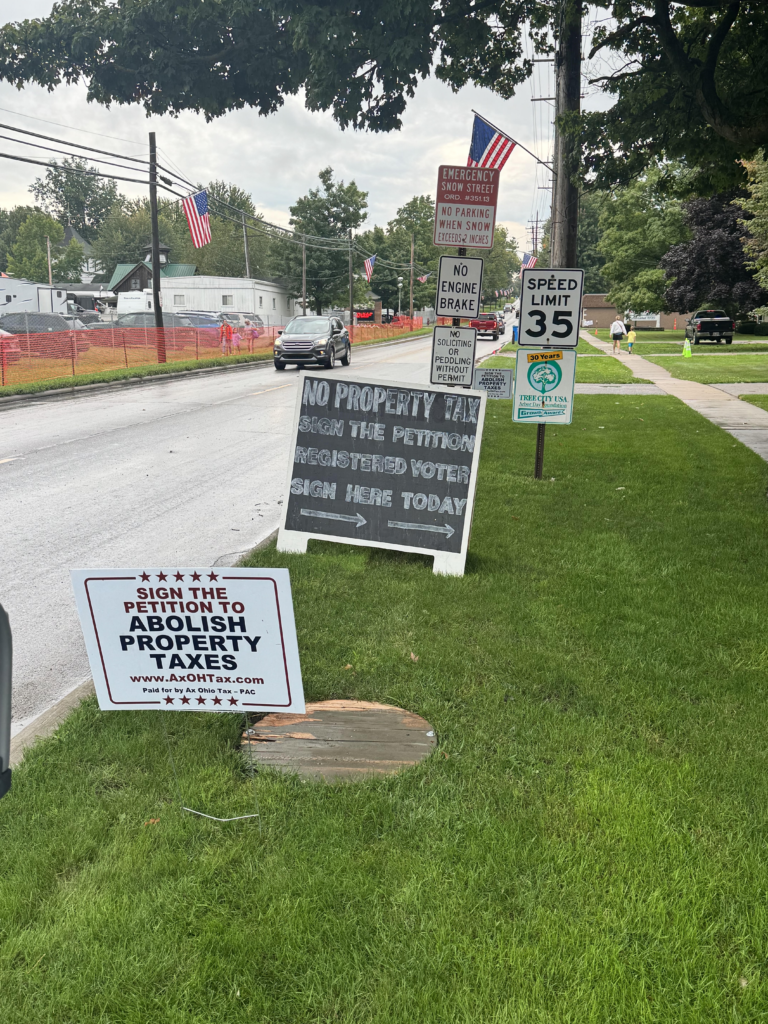
We are calling out the Geauga County Fair Board members for to shutting us down from collecting signatures at the Geauga County Fair, thereby violation the First Amendment of the Constitution of the United States of America.
Petitioning to collect signatures is protected under the First Amendment as it is considered "core political speech." Core political speech refers to expressions intended to rally public support for a particular issue, position, or candidate, and it receives the highest level of protection under the First Amendment. This right allows individuals to express their opinions and seek change without government interference.
Who is responsible?
Answer: The Geauga County Agricultural Society (Fair Board), governed by 21 elected directors representing the county’s townships and at-large positions, is responsible for the potential violations.
Board Officers
● Wendy Anderson – President (Parkman Twp.)
● Keith Chapman – Vice President (Montville Twp.)
● Meg Noah – Secretary
● Diana Cochran – Treasurer
Board Directors by Term Expiration:
The board’s 21 directors serve staggered terms expiring in October of 2026, 2027, and 2028:
● Term Expiring October 2026: Curt Canfield, Cheryl Carr, Keith Chapman, Jim McCaskey, Esther White, Doug Logan, Mark Shaver, and Bob Phillips.
● Term Expiring October 2027: Wendy Anderson, Dale Ryan, Tyler Plants, Howard Bates, Terry Zion, Carl Langer, and Brian Workman.
● Term Expiring October 2028: David Parker, Pam Krotzer, Matt Dolence, Scott Mihalic, Mike Sestak Jr., and Tim Blair.
The Geauga County Fair Board would not sell us a booth within the fairgrounds, and even told us that we could not be on private property within 1,000 feet of the fair entrance. They even told the Sheriff’s Department when the fair started to shut our booth down located on private property. The Sheriff’s Department reminded them that it is PRIVATE PROPERTY.
In the United States, the right to petition the government is protected by the First Amendment. This right supports collecting signatures in many public spaces and during organized events.
We did not realize that there are so many socialists in Geauga County. Freedom and liberty is not their goal, and private property only counts when it is THEIR PROPERTY. Support the government at all costs is their motto because they are getting money from the State of Ohio and the County of Geauga. Love thy neighbor is merely a suggestion, and not a commandment for the Geauga County Fair Board members.
Here is a picture of our response to the directors of the fair board.
COMMISSIONERS SEEK SUMMARY JUDGMENT IN GRENDELL MANDAMUS
Thursday, August 27, 2026
Nearly two years ago Probate/Juvenile Court Judge Timothy Grendell approached Geauga County’s Commissioners to request that they pay for the legal fees accrued during the widely-publicized disciplinary case filed against him by the Ohio Board of Professional Conduct and the Ohio Supreme Court. At that time the anticipated cost of attorneys to defend his law license was $300,000. Ultimately, the hearings against Grendell resulted in the 18-month suspension of his license with 6-months suspension dropped .
The requested $300,000 was for completed private attorney services already undertaken, but he also asked to be permitted his personal choice of an attorney to represent him in an appeals case filed in Ohio’s Eleventh District Appeals Court without utilizing the procedure outlined in O.R.C.309.09(A) involving the input of the Prosecuting Attorney.
The Appeals Case that resulted, 25G000028, is captioned State of Ohio, ex rel. Judge Timothy Grendell, Relator, vs. Geauga County Board of Commissioners, et al., Respondents. It is a mandamus action.
On August 20, 2026, Commissioners’ attorney, Frank Scialdone, filed electronically his response reply in support of summary judgment. A ruling of summary judgment against the Relator would effectively put an end to the litigation and therefore dismiss the mandamus action. Attorney Scialdone has stated in his latest response that the tenets of 309.09(A), 305.14(A), and 305.17 establish clear cut guidelines by which outside counsel can be employed to represent a county officer engaged in “official capacity.”
In addition, Scialdone asserts that as an action in mandamus, the relator’s action must clearly prove that the Commissioners have had the duty and responsibility to pay for his defense of his own suspended legal license; in consequence of his actions, Timothy Grendell’s ability to practice law was removed from him, along with his salary. In practicality, Attorney Scialdone states that the relator’s mandamus demand for “appointment of outside counsel is moot and futile” because “disciplinary proceedings against the relator have conclusively ended.”
Notes Attorney Scialdone,”If Relator’s argument were accepted, the statute on which he relies would require the Board of Commissioners to provide a taxpayer-funded defense to every public officer who commits ethical violations while on the job, whether it be a violation of the code of judicial conduct, the acceptance of a bribe, or other unethical conduct.” As a result, “Respondents have no clear legal duty for such a judge’s defense.”
TOTALLY UNMANNED FIRE DEPARTMENT PROMPTS 3-HOUR PACKED PUBLIC TOWNSHIP MEETING MONDAY, AUGUST 17, 2026
Tuesday, August 18, 2026
For regular Auburn Township public meeting-goers, it was important to arrive 10-15 minutes before the scheduled 7 pm meeting to guarantee a seat. By 6:50 pm it was evident that this regularly-scheduled meeting was going to be important just from the sheer numbers of spectators locked out of the township Administration Building. Some of the word going around was that we were waiting on an the conclusion of an impromptu Executive Session. The rest of the chatter in the parking lot was that an impromptu visit from a couple of individuals to the Auburn Fire Department on Sunday, August 16, resulted in the discovery of a totally vacant, but unlocked fire house that should have been staffed with at least one or two members of the “Volunteer” Fire Department, but per the 2026 Fire Contract that trustees approved in December 2025, four 24-7 staffers had been approved and paid for by Auburn taxpayers.
A few minutes after 7 pm Trustee P.J. Cavanagh opened the locked door, revealing all three trustees, the fiscal officer, the fiscal officer’s assistant, the road superintendent, the fire prevention officer, and the Assistant Prosecutor for the township, Crissy Rine, who was just gathering her gear to exit the Executive Session. Well, it would seem the chatter in the parking lot had indicated some serious breach in conduct. The next objective was finding a front row seat with clear audio and anticipating a video of the meeting that would communicate transparency and a solution to some serious problem.
Road Superintendent Mike Fenstermaker gave a lengthy report on automotive repairs as well as cleaning up fallen trees resulting from high winds on multiple residential roads and removing a deceased deer from a ditch, and reporting on the replacement of concrete driveway aprons with asphalt adjacent to new asphalt on township roads. Finally Fenstermaker provided updates on the 2027 road projects:
Crackel to Munn (with grant money and half payment by Mantua Township)
Crackel 2 (Thorpe to Auburn) with grant money
Waterford
Indian Hills
Fox Road
Thorpe to Bartholomew (with Crack and Seal)
Fire Prevention Officer John Phillips gave his report next.
Traditionally Trustee Cavanagh was next in line to give a report in which he expressed objection to the use of the term “threat letter” in the official minutes taken on the evening of Monday, August 3, 2026.
Traditionally the second elected trustee to report publicly, Riley Davis, bluntly reported that on Sunday, August 16, the Auburn Fire Department was totally unstaffed. Thus, two Auburn residents found the Fire Department building open and accessible to anyone who had dishonorable intentions, like wishing to abscond with equipment or cash on hand. Perhaps even more unsettling was the idea that anyone seeking emergency medical assistance from qualified EMT personnel at the fire station would discover that a wiser decision might be to drive directly to Geauga Hospital Emergency Room; but without knowing from the outset that the Auburn Township Fire Department was totally unmanned in the first place, a parent or associate would find himself/herself burdened with the extra time constraints of finding enough medical aid to prevent or to solve a potential catastrophe whose solution depended on a limited time frame for successful resolution.
Trustee Davis proposed a number of questions for Fire Board member Matthew Scharfenberg:
1) Are there any times wherein the 2026 Auburn Township fire contract authorizes the fire station totally unmanned?
2) What documentation supports the premise that the Auburn fire station had any manpower while Bainbridge was down to 4 EMT personnel?
3)Was dispatch made aware that the Auburn Fire Station had no personnel on Sunday, August 16?
4)Who is responsible for staffing the Auburn Fire Department 24/7?
Fire Board Vice President Matt Scharfenberg, in attendance at the Trustee meeting, asserted that the Fire Board will take responsibility for notification of minimal or 0 manpower at the Fire Department by phone or email. Vice President Scharfenberg acknowledged the responsibility for ultimate staffing at the Fire Department, noting the Fire Board’s expectation that several full-time “volunteer” personnel would be staffed in January 2027, the onset of the newest Fire Department contract, which if approved by Auburn Trustees in December 2026, will reflect a 5% inflationary pay increase over the 2026 (current) fire contract unanimously trustee-approved contract in December 2025 without being subject to scrutiny by the Geauga Prosecutor’s Office.
5) Does the Fire Board accept the premises of performance review and of job description for the Fire Prevention Officer?
After Trustee Davis established that at the December 2025 trustee approval of the 2026 Fire Contract, he was not yet a member of the Auburn Township Board of Trustees, PJ Cavanagh conceded his disappointment with Sunday’s total lack of manpower within the Fire Department.
Scharfenberg quietly stated that the Fire Board is in charge of all fire department operations,
As the discussion focused upon the Tuesday, August 18, monthly Fire Department open to the public, there was emphasis on Auburn Township residents’ approval for paying for four adequately-qualified Fire Department employees per shift and therefore those residents being entitled to receive the quantity/quality of safety-oriented service under the 2026 Fire Contract. Sunday’s 0 manpower coverage raises the question if nonperformance is a function of being caught in the deliberate act of nonperformance. Since the Fire Board accepts the premise of its complete control over operations, it should follow that the same Board has the power of changing one or more line officers, even though Scharfenberg in the same breath acknowledged that only the Fire Prevention Officer (Phillips) has incorporated the power of changing officers.
Patty Phillips, aka the wife of Fire Prevention Officer John Phillips, questioned how Trustee Davis would be in a position to judge the conscientious and constant dedication, good judgment, and hard work performed by those individuals governed by the 2026 Fire Department contract and why Trustee Davis would feel the confidence to be in judgment of such a group of individuals with such high standards of morality and performance. Trustee Davis replied that he has served as a fireman for a larger and busier fire organization than the one serving Auburn Township. Further, Davis reiterated the Fire Company’s accepted responsibility for making judgments that said Auburn Fire Company exerts full responsibility for the community’s complete physical safety and well-being, first and foremost.
Another audience member was heard to identify the failure of Fire Department operations on Sunday, August 16, as “an isolated event” for which there should be no negative feelings held by the taxpayers of Auburn Township. At this point Fiscal Officer Dan Matsko noted that some 44 years earlier he decided to be a volunteer fireman who received no monetary rewards for his own commitment to community safety.
An audience attendee who identified herself as a scout organizer, appeared to ask questions unfortunately utilizing innuendo and/or sarcasm, thereby fostering more emotional and psychological division than problem solution.
Scharfenberg took the time to speculate whether a Fire Board with full responsibility for Fire Department actions would have achieved staffing on that 0 staff day and concluded that he was really not certain that certain factors, like the intensity of August summertime would have facilitated the “right “ answer. Trustee Troyan, Fire Department liaison, in the absence of providing a trustee report for as long as this writer can recall his elected career in Auburn Township, noted that Fire Department staffing has been a consistent problem, not a rare, random act.
Trustee Davis noted, “Effective immediately, the Fire Board will control all staffing.
P.J. Cavanagh offered to read the text of the 2026 Fire Contract but seemed concerned that such an act might result in “unintended consequences.” Fire Prevention Officer Phillips noted that the cited contract “is already clear.” Fire Board V.P. Scharfenberg added at this point that “the Fire Board has always had the authority and control of all aspects of operation of the Fire Company,” such as signing paychecks, although he did not have personal knowledge that a line officer could be changed.
In response to attendee Deb Stanley’s defense of the Fire Department’s Sunday’s 0 staffing and her recommendation “to move on,” Trustee Riley cited the Geauga County Budget Commission’s concern for the Fire Department’s $1.3 million budget for problems that had not apparently been caught, as well as the Budget Commission concern for Geauga taxpayers being used unfairly by the system and thereby not receiving the township services for which they had already paid.
At one point a member of the audience suggested that Fire Prevention Officer John Phillips, though not having qualification as EMT, still has a yearly income of at least $126,000, without a performance review or a job description for Fire Prevention Officer. In addition, Trustee Davis reminded Phillips that requests for Phillips to return information made nine months prior still remained unfulfilled. Had Phillips been in violation of contract requirements?
Fiscal Officer Dan Matsko reported that he and the Auburn Trustees had appeared before the Geauga County Budget Commission (Prosecutor Jim Flaiz, Auditor Charles Walder, and Treasurer Chris Hitchcock) and had learned on Monday afternoon that the 2027 Auburn budget was approved.
He also reported on total payments of $546,568.36 that he had made between August 3 and August 17, including a payment of $494,080.00 to Phillips Paving, Inc, on August 17.
The subject of Adam Hall roofing came up again.
14 days after the public hearing on ZC2026-01 on Monday, August 3, 2026, Trustees voted 3-0 to prohibit data centers in Auburn Township, establishing blanket denial for development.
The next Auburn Township Trustee meeting is scheduled for Tuesday, September 8, 2026, the day after Labor Day, at 7 pm, at the Administration Building, on East Washington Street.
GEAUGA DOG WARDEN PROPOSES FIRST FEE INCREASE SINCE 2013
Wednesday, August 19, 2026
Dog Warden Matt Granito brought Geauga Commissioners a special guest for Show and Tell on August 18, a small ginger-colored, wavy fur-ball with constantly wagging tail, huge soulful eyes, kiss-planting tongue, and earnest wish just to be held close and cuddled. As far as Matt was concerned, the individual who found her roaming the streets of Middlefield just a few days before was probably going to be back at the dog shelter the day after the Commissioners’ Meeting o provide her a permanent, loving, responsible home. Otherwise. this little 1-2 year old people-loving-pooch might turn out to be Matt Granito’s perfect marketing tool to promote the construction of a brand-new financially-solvent dog shelter.
Mango, a Cockapoo, was charming several members of the Media seated at the front table with her joy at being petted and stroked. Although some dogs have learned to fear or distrust individuals who reach for them assertively or aggressively, Mango just wanted to move right into that physical contact.
Even better, at no time did she get so excited that she lost
control of any bodily functions through excitement or nervous energy so she was
a real live cuddly, teddy bear, never even resorting to a bark whole time at the
front table in Room 303, while Matt explained his real reason for being there,
Agenda Item #12:
The Dog Warden [and Shelter] are requesting the Board approve and execute Resolution #26-128 Authorizing an Increase e in Dog and Kennel Registration Fees in Geauga County, effective beginning December 1, 2026, for the 2027 Dog and Kennel Registration Years, in accordance with O.R.C. 955.15, increasing a one-year dog registration to $20.00, a three-year dog registration to $60.00, a lifetime dog registration fee to $200.00, and kennel registration to $100.00.
Warden Granito also brought a 4 page handout explaining why the annual fee increase from $15 to $20 is so important for the success of the new shelter. Geauga County has not increased its annual dog registration fee since 2013, although both responsibilities and expenses, including veterinary care, medications, dog food, cleaning supplies, utility bills, vehicle fuel and repair bills, employee wages, amd law-enforcement expenses, certainly have inflated.
One of the most significant extra burdens for dog wardens in recent years is the need to assume “responsibility for dogs when [their] owners unexpectedly become unable to care for them.”Many of us remember Warden Granito’s explanation of Avery’s Law, officially House Bill 247. As a result dog wardens found themselves learning about amended dog laws this year in Ohio and dealing with animal neglect exhibited by animal owners, required participation in court and legal actions, involvement with dog-control agencies, and other complications unforeseen back in 2013.
One of the most unforeseen needs for the Dog Warden is the replacement of the 45+ year old Geauga Dog Shelter. The Dog Warden’s Office has been operating at a deficit since 2021; that deficit during 2026 now stands at $60,308.25 The Dog Warden is hopeful that the increased registration fee for 2027 will provide improved revenue stream to ensure the success of the Dog Warden’s Office and an improvement in life quality for dogs like extraordinary Mango.
With some good fortune Mango may hopefully be finding her new owner and permanent home today. In this writer’s opinion, Mango deserves nothing less to demonstrate her total love and loyalty.
Bravo, Matt Granito! Hurray, Mango!
NOTIFICATION OF ANNUAL GEAUGA 2027 TAX BUDGET HEARINGS:
AUGUST 17 & 18, 2026 beginning at 9 am on Monday& Tuesday Lunch break @12:15 pm; afternoon session @ 1:15pm Auditor’s Appraisal Room @ 231 Main Street
Please note that it’s that time of year again: 2027 budget approval time
Note that the August 11, 2026, Geauga County Board of Commissioners updated Agenda carried notice in Item 15 of its upcoming Budget Commission hearing as the last item of business on the 1:15 pm Monday session.
Agenda Item #15:
The Commissioners’ Office is requesting the Board schedule a special meeting ON Monday, August 17, 2026 at 2:30 pm that will be held concurrently with the Geauga County Budget Commission, to be held in the Auditor’s Appraisal Conference Room, located at 231 Main Street, Chardon, Ohio.
Additionally, readers be informed that there will be morning budget hearings for townships that same day at 9am and 10 am and the afternoon session that will hear in order 2027 budgets for the townships of Newbury, Huntsburg, Middlefield, and Auburn, followed by Geauga-Trumbull Solid Waste, and the above-captioned Commissioners’ Office [aka Geauga County], the last budget to be heard that day.
Please click HERE for the entire two-day annual tax budget schedule and check with Auditor Walder’s website for video records of the results..
MORE SURPRISES FROM TREASURER’S EMPLOYEES
Wednesday, August 12, 2026
As readers may recall, on Tuesday, August 4, Geauga County Treasurer Christopher Hitchcock and
Deputy Treasurer Caroline Maxwell appeared in Commissioners Chambers, where Hitchcock presented a “Supplemental Appropriations request regarding wage increases [for Treasurer’s Office employees but not including Deputy Treasurer Maxwell] in Agenda Item #4. Treasurer Hitchcock presented his argument in favor of raises of 22%-24.9% for Treasurer’s Office employees, based on these individuals’ ability to perform co-workers jobs interchangeably.
Because Commissioners were unprepared for the unconventional timing of the raise requests, all three demonstrated their willingness to provide a reasonable offer, albeit significantly less than 22-24.9%.
The updated 17-item agenda from Tuesday, August 11, went off with a two-Commissioner quorum of Ralph Spidalieri and Carolyn Brakey. President Jim Dvorak was not present. Having gotten through fifteen of seventeen items with no delays, Assistant County Administrator Jimison announced that there was no board discussion topic for Agenda Item #16, providing Spidalieri a perfect segue to broach “things in the Treasurer’s Office.”
Commissioner Spidalieri welcomed the invitation from Commissioner Brakey as he identified “a communications breakdown,” even as he had been searching, he said, “for common ground” between the Commissioners and the Treasurer’s Office. Spidalieri clarified that by Wednesday, August 5, the Commissioners had received a letter directly from Treasurer’s Office employees “that had left a bad taste in the mouth,” especially since Deputy Treasurer Maxwell had claimed no knowledge of Treasurer’s Office employees’ direct communication to Commissioners.
Commissioner Brakey remarked that the Treasurer’s Office employees had “advocated well for themselves,” but in the process “had off-put” her.
Spidalieri shared that he had responded back to the Treasurer’s employees on Friday, August 8, and in a second letter dated Monday, August 11. First, Spidalieri, in looking back over his time in office since 2012, recalled that Treasurer employees had been granted a 3% annual raise every year except “one or two during the Covid, when they didn’t know what was going to happen. He cited that a 3% raise nearly every years for each of his fourteen years in office “ could provide a raise of perhaps 30% over the time period. . .” Next, he cited employees’ 15 days off during the work year, medical benefits, and vacations.
Further, Spidalieri claimed to have heard from many Geauga County residents, for example, those reacting to the Treasurer’s stated offer of 22%- 24.95% with anger and disbelief. Adding that he had heard from a large segment of county residents involved in banking and financial services, Spidalieri noted that those in private financial services typically thought that their own benefits were less generous than those extended to Geauga government personnel.
Spidalieri continued to express his disappointment that the Treasurer and Deputy Treasurer were not on the agenda that day and he has not heard back from either individual as of Tuesday, August 11.
Spidalieri’s approval of the 3% raise for 2026 plus an additional of 5% as a result of Hitchcock’s latest request will remain his top offer. Commissioner Brakey agreed.
When Adrian Gorton asked if he should figure on adding in that 5% for Treasury employees or “leave things alone,” he was told to do the latter to provide the way for more talks between the two areas of Geauga government.
COUNTY ROAD AND BRIDGE LEVY ON NOVEMBER 3, 2026, BALLOT
Wednesday, August 12, 2026
This is just a reminder to Geauga County residents eligible to vote on the Tuesday, November 3, 2026, election that many of you are aware of partisan issues to vote on. There will also be monetary issues, levies, requiring a majority vote for approval. Among those levies to be decided on November 3 is Geauga County’s Road and Bridge Levy renewal, first approved by Geauga voters in 1986. It is a 2.5 mill levy, as described by County Engineer Andy Haupt on July 21, 2026. Readers may remember that the video camera could not be focused on individuals presenting Agenda Items to the Commissioners, but remained focused on the back wall of Commissioners’ Room 303 for the entire meeting.
Agenda Item # 10 read as follows:
The County Engineer’s Office is requesting the Board approve and execute Resolution #26-115 Declaring it Necessary to Levy a Tax in excess of the Ten Mill Limitation as authorized by Sections 5705.03, 5705.19, and 5705.25 of the Ohio Revised Code for renewal of two and five tenths (2.5) mills levy for general construction, reconstruction, resurfacing and repair of streets, roads and bridges in Geauga County.
Engineer Haupt explained that he was first hired in the Engineer’s Department in 1996, ten years after the initial passage of the pro-active 2.5 mill levy. According to Engineer Haupt, the levy provides 27-30% of the Engineer’s funding and enables continuous maintenance for county roads that are safe, open-for-commerce, and travel-sustainable. Because voters on November 3 will decide the fate of a qualified levy, both local dollars and state money will allow the Engineer’s Department to apply for available grant money. As a qualified levy, this R & B issue provides funding for eight large county road projects per year, according to Engineer Haupt.
Remember to cast your vote Tuesday, November 3.
AUBURN WORKER PLEADS GUILTY TO FELONY
Wednesday, August 5, 2026
Nancy R. Dolezal, age 72, completed 19 years of employment for Auburn Township before announcing her retirement in early spring 2026. By the first week in May she had personally received an indictment from the Geauga County Grand Jury following an investigation into missing township money relating to the sale of two cemetery plots.
The Grand Jury returned one count of theft in office and two counts of tampering with records tied to two missing township funds. All three were felonies; the accusation of theft in office was a fifth-degree felony, the remaining two charges were each third-degree felonies. Under Ohio law, each of the third-degree felony charges carries a prison term of nine to thirty-six months; the fifth degree felony charge carries a prison term of six to twelve months.
Having initially entered a not-guilty plea, the defendant was represented by hired counsel, received permission from the court to travel out-of-state for vacation plans and return date prior to the August 5 trial/plea date for Case 26C0066, State of Ohio v. Nancy R. Dolezal, under Judge Carolyn Paschke.
Mrs. Dolezal pled guilty to one count of tampering with records on August 5 and was thereby sentenced to two years of community control with the remaining two charges were dismissed. All court costs were assigned to Mrs. Dolezal.
Since the May indictment, Auburn Township has resolved any question regarding the sale of cemetery plots.
GEAUGA TREASURER CATCHES COMMISSIONERS OFF GUARD
Wednesday, August 5, 2026
Treasurer Christopher Hitchcock and his Chief Deputy Treasurer, Caroline Maxwell, made their joint appearance on the August 4 Agenda after Maxwell’s solo appearance the previous week when she announced that “Chris could not make it,” and Commissioner Brakey asked for more documentation so she could accurately “do her homework. Hitchcock’s and Maxwell’s joint appearance to present Agenda Item #4 was the offshoot:
“The Treasurer’s Office is requesting the Board discuss a Supplemental Appropriations request regarding wage increases, as a result of a salary study that was completed.”
Last week Maxwell did the talking, but this week she advised that Treasurer Hitchcook would be doing the talking. Sure enough, in doing the talking to the Commissioners, he noted that real estate payment “delinquencies are down,” implying that very few Geauga taxpayers receive a 10% penalty or wind up on the road to more serious consequences, such as subjection to real estate foreclosure procedures, or worse, the loss of real estate titled to them. Hitchcock appeared to attribute the taxpayers supplying the real estate collection, sometimes in so much currency that Hitchcock claimed that the Treasurer[‘s Office collected $50,000 in cash on August 3, the day before the closing real estate collection for Second Half of 2025. Hitchcock went a step further: “I hate cash, but we are required to accept it.” [Receipt of| $25,000 in cash in the office entails delivery with the Sheriff to the bank.”
Turley noted that the lengthy study started with a comparison of Cuyahoga County Treasury employees, then focused finally on comparison with the salaries of Geauga County employees. When Commissioner Brakey asked about significant requirements and/or training undertaken by the Treasurer’s staff that make them special or irreplaceable, Turley explained that the five Treasurer’s Office employees have interchangeable skills so that they can fill in for each other.
Hitchcock claimed that employees deserved 22-24.9% raises, raising the question of the absence of this supplemental monetary request now, rather than during budget hearings.
Brakey responded bluntly, offering a 10% raise now with reevaluation to recur at the end of the year in 2026. Hitchcock attempted defending his staff can’t possibly catch up to the pay schedule offered in other Geauga County Departments.
Commissioner Spidalieri rationally and evenly countered Hitchcock’s line of attack. A raise to Treasurer’s Office employees “sits wrong.” Spidalieri couldn’t Hitchcock’s pay raises because they would cause “spiraling financial” unrest, as he offered mutual support for Brakey’s 10% offer In fact, any money offer larger than 10 % only made Spidalieri feel uncomfortable about its “excessive nature.”
Commissioner Brakey thought of one more detail and verified that Deputy Auditor Maxwell was not to be included in the five Treasurer’s Office up for 22-29.5% raises.
Spidalieri was very motivated: “Rather than take a vote, we should regroup. Let’s table and come back [with a different plan].
AUBURN’S KITKO STILL LOSES IT OVER “SECOND DWELLING”
Wednesday, August 5, 2026
The public hearing concerning the permissibility of data centers within Auburn Township, Geauga County, Ohio having been closed, there was a hiatus of five minutes before the regular meeting was called to order at 7 pm.
Frank Kitko, zoning inspector, referred to the latest attempts, to schedule an executive session subject to the availability of Assistant Prosecutor, Kristin Rine anytime after the Fourth of July. Trustee Riley Davis favored Rine’s participation in executive session for the next trustee meeting on Monday, August 17.
Citing that Troyan’s individual communication to Geauga County Planning Director, Linda Crombie, had been drafted outside a public meeting, Troyan justified his action apart from the other two trustees as action as an individual separate from a township outcome. Meanwhile, no updated action from Rine became known by adjournment of the meeting at 8:40 pm.
The topic of “second dwelling,” under discussion for multiple meetings, arose again with Frank Kitko loosing calm demeanor, as he explained that a resident had identified real estate for sale with two vacant buildings identified as “dwellings.” Until one or both dwellings were occupied by an individual or individuals moving in, Kitko conceded there was no issue for him to resolve, but the tone of his voice was elevated and defensive.
Shortly thereafter the topic of “search warrant” and its definition and/or in a civil court situation arose with some explanations from resident Marty Brewer.
During the course of this discussion regarding the funds permitted Mr. Kitko to pay an attorney besides the Geauga Prosecutor’s Office, there was recognition that the $5000 allotment was nearly exhausted.
During his report time, Trustee Cavanagh identified a Planning Conference in Geneva (Lake County) in the near future to provide up-to-date information about the impact of Data Centers. Cavanagh emphasized encouraging the attendance Auburn Zoning and Board of Zoning Appeals members at this planning conference by reimbursement for their attendance.
Trustee Davis reviewed the new Auburn Township website with its “Widget” at a cost of $240 per month and an annual cost of $2700 per year.
As typical, Trustee Michael Troyan waived his time for Fiscal Officer Dan Matsko’s monthly financial report. From July 21- August 3, 2026, total payments of $45,301.72 were made.
There were several items dealing with New Business on the agenda. First, trustees voted unanimously to waive a liquor license hearing request for The Mercantile, which is engaged in the sale of carryout beer. Secondly, the new administrative assistant completed ninety days of employment, her official period of probation. Currently considered a salaried employee, the administrative assistant has been receiving the equivalent of $25 per hour. Trustees approved her status as an hourly employee, and voted unanimously to award her a $2 per hour increase. As the only full-time employee, the administrative assistant is not eligible for overtime. In additional New Business, Geauga Engineer Andrew Haupt recommended the address of 11039 Bartholomew Road for Auburn Township parcel 01-11925.
In the final action during New Business, the rescue of Penelope Crawford from a drowning on July 4, 2026, resulted in the Auburn Fire Department’s Proclamation of Heroism to be awarded to the following individuals: Parker Crawford, Gretchen Wither, Elaine Sargent, Michaela Green, and Marsh Lella,
The Auburn Township Trustee Meeting Adjourned at 8:40 pm with the next regular trustee meeting set for Monday, August 17 in the Administration Building at 7pm. Blood Drive is to follow August 19 at Adam Hall from 10 am-3pm.
PUBLIC HEARING SET FOR AUBURN TWP. ZONING AMENDMENT ZC-2026-01 PRIOR TO REGULAR TWP. TRUSTEE MEETING OF AUG. 3, 2026
Wednesday, August 5, 2026
Geauga County Planning Commission vote on July 14, 2026, recommended denial of the above mentioned township zoning amendment while clarifying four types of data centers according to size: Micro (300-3000sq. ft.), Enterprise (5000-50,000 sq. ft.), Co-location (50,000-600,000 sq. ft.), and Hyperscale (100,000s sq. ft. per building). Auburn Twp. has two zoning districts (B4 Office/Light Industrial) and I-1 (General Industrial), where “relatively quiet, free of objectionable or hazardous elements” and businesses concerned with “distribution, packaging, cleaning plant supplies, metal work…, photographic, processing, printing and publishing,… glass, plastics, rubber , textiles. Appliances, office supplies, small machinery, automotive parts, and/or processed products including but not limited to cosmetics, drug, food, pharmaceuticals, and toiletries,” respectively. . . , the township has relied upon the following zoning premise: “If a use is not specifically listed, it shall not be permitted.
Although the township has been largely successful requiring permitted uses to be listed, a non-listed data center could become the subject of court litigation of a use variation, or imposition of a data center by amendment.
Linda Crombrie, Planning Director of the Geauga County Planning Center, notified the Auburn Twp. Zoning Commission Secretary, as well as Asst. Prosecutor Susan Wieland and Joan Hardy, Auburn Township Zoning Secretary.
Those in attendance at the Auburn Public Hearing were curious to hear any updates regarding how Shalersville in Portage County was coping with the complexity of a 257 acre site to be developed by Geis Development and Bitnes Technologies, the site of a huge data center with a centralized cooling center. Geis already owns 130 acres, about half of the entire development and about $80 million worth of investment.
Trustee Michael Troyan on his own decided to contact a Shalersville elected official and notified Trustee Cavanagh. Neither contacted Trustee Riley Davis about Troyan’s contact until the actual public hearing. Troyan reported that the contacted Shalersville official advised Troyan, “Go with prohibition on data center zoning as soon as possible.”
The public hearing, initiated at 6:30 pm was closed at 6:55pm with no argument posited in favor of the Shalersville “Big Data” Center. Additionally, trustees can take a vote on Amendment ZC 2026- 01 within 20 days.
FEDS ISSUE WARNING ABOUT HACKERS TARGETING WATER SYSTEMS
Saturday, August 1, 2026
Jill McLaughlin
A federal cybersecurity agency warned water systems throughout the United States on July 30 of an increase in threats to water and wastewater systems.
“These threat actors are targeting water entities of all sizes,” the Cybersecurity and Infrastructure Security Agency (CISA) stated in the alert.
CISA, the agency that coordinates national responses to cyber and physical threats, issued the notice after more than 30 community water systems in Minnesota were hit with a coordinated cyberattack.
Minnesota IT Services activated emergency protocols immediately after the attacks on July 26 and July 27, and began an investigation that continues this week.
Among the communities affected by the breach was the city of Braham, also known as the “Homemade Pie Capital of Minnesota.” City officials announced its water plant was “offline for an unknown reason” at about 9:30 a.m. on July 27. The water was back online two hours later.
“Crews identified that the water plant outage was a result of a malicious cyber-attack of computerized operating systems by unknown actors,” the city said in a release.
The FBI is investigating this week’s cyberattack in Minnesota but has not publicly identified what organization was responsible.
The FBI, CISA, and other federal agencies warned last week that Iranian hackers were targeting water and wastewater systems and operational controls of other critical infrastructure.
The agencies advised water systems to check operation programs manufactured by Rockwell Automation, Schneider Electric, Siemens, and other manufacturers.
In its latest alert July 30, CISA urged critical infrastructure owners, operators, and integrators to remove computer-automated systems and other technology from the internet as soon as possible.
Hackers targeting the systems have changed passwords to lock out operators and disconnected the systems by changing their IP addresses. The activity resulted in boil water notices and manual operations, CISA warned.
Water systems with proven cybersecurity systems were still encouraged to validate their external connections.
Targets for the threat actors include cellular modems installed by operators, vendors, or system integrators that may not be documented or included in routine scans, the agency said.
Tenable, a security exposure management company, theorized the cyberattack in Minnesota related to the escalating Iran conflict.
“Federal and state officials have not publicly attributed the Minnesota attacks to any specific actor,” Tenable stated in a July 28 post on its website. “However, the operational pattern is consistent with the CyberAv3ngers threat ecosystem, a state-directed group the U.S. government has formally attributed to Iran’s Islamic Revolutionary Guard Corps Cyber-Electronic Command.”
VOTE ON GEAUGA TREASURER DEPARTMENT WAGE HIKES TABLED FOR ONE WEEK STUDY
Wednesday, July 29, 2026
Geauga County Chief Deputy Treasurer, Caroline Mansfield, joined County Fiscal Officer, Adrian Gorton, during his reading of financial items [Agenda Item # 5] during the July 28 public meeting, to address a full body of Geauga Commissioners: James Dvorak, Carolyn Brakey, and Ralph Spidalieri. Gorton was accounting for the most recent encumbrances, Opioid Recovery funds, and annual professional conferences.
Commissioner Brakey, spotting Ms. Mansfield in attendance, identified some documentation received from the Treasurer’s Office late the day before that she claimed not to understand and asked for Ms. Mansfield to come up and join Gorton while providing more clarification.
Gorton noted that an internal Treasurer study regarding pay levels within the department had long been under discussion and finally began in earnest in January 2026. Ms. Mansfield added that the last hourly pay raise for Geauga Treasury Department employees occurred in 2005. The most recent internal study resulted from a FOIA request, whereby Geauga Treasury employees’ wages and responsibilities were compared with the wages and responsibilities of county treasury department employees in surrounding northern Ohio counties, namely, Lake, Summit, Ashtabula, Cuyahoga, Trumbull, and Portage. In attempting to make the comparison between Geauga and Lake County Treasury Department employees, the discovery was made that the Lake County Treasury Department is not even involved with the same duties and responsibilities, thereby making a comparison impossible; the study revealed that the Lake County Treasurer’s Office “is more real-estate oriented.” In general, Ms. Mansfield concluded from the seven-month study that employees from her department are earning $5-$15 per hour less than Geauga county employees with fewer responsibilities; in particular, she cited two female employees upon whom she often depends. Noting that Treasurer Hitchcock could not be in attendance that particular morning, Mansfield stressed the former’s interest in “truing up” to establish a “fair wage” within his department.
In response to Brakey’s inquiry. Mansfield acknowledged receiving merit raises of 2-3% a few years before, but no hourly raise since the 2005 action. Gorton noted that he had enough financial flexibility that any decision could wait until the August 4 meeting. Brakey asked for more time and documentation to be able to study the issue more thoroughly, and Gorton asked to exclude the Treasury Department issues, which he identified as Supplemental 2026-2513 and Supplemental 2026-2512, from the Financials presented for approval.
In an oral vote, Commissioners approved the Financials with the exclusion of the above-cited two Supplementals 3-0; Commissioner Brakey asked to table the discussion of the Supplementals until the Tuesday, August 4, Commissioner meeting, when Chief Deputy Treasurer Mansfield is expected to be in attendance again and commissioners can claim an extra week to do their homework.
MONDAY, JULY 20, 2026: AUBURN TOWNSHIP TRUSTEE MEETING
Thursday, July 23, 2026
The second trustee meeting of July began promptly at 7 p.m. with all three trustees, fiscal officer, and fiscal assistant all present. Guest for the evening was NOPEC appointee Jeff Heinrich.
First to provide a scheduled report was Mike Fenstermaker, Auburn Road Superintendent, reporting on “a lot of ditching” completed and a “lot of road holes” filled, along with the setting up of fireworks for July 4, emptying of trash in the park on a weekly basis, clearing of downed trees resulting from July 3 storms, getting Truck 18 back after extensive repairs. In addition, the road department cleaned up about five pounds of roofing nails spilled on the roadway; these managed to inflict several flat vehicle tires before their cleanup. In addition, Mr. Fenstermaker reported on several burials completed. Also, there was the purchase of ODOT salt from Morton at $55 per ton for 2200 tons for the upcoming 2026-2027 winter season.
John Phillips, Fire Prevention Officer, gave his report on the number and kind of service calls for the period.
Jeff Heinrich, cited above, clarified that an energy efficient roof would qualify for a NOPEC grant, as would a back-up generator.
Trustee reports followed, with P.J. Cavanagh noting some error recording witnesses during three meetings at the Administration Building on July 6, 2026. Tanya Rogers represented OTARMA at one of those three meetings, as correctly noted, but the meeting that listed Assistant Prosecutor Kristin Rine was inaccurate, according to Cavanagh.
Riley Davis reported on the plans for the antiquated TV that was recently replaced by a new monitor; trustees voted unanimously to destroy the old TV because of its advanced age and worthlessness. In other business, Davis commented on offensive yellow road signs tacked too strenuously to telephone poles to be dislodged and advised of his checking with ODOT for advice. He asked for assistance in removing the offensive advertising to help keep Auburn Township beautiful. A legal notice regarding roof installation will go out, with received bids to be read at the August 17 trustee meeting; Mr. Davis checked with Fiscal Officer Dan Matsko regarding expected expense allotted.
Cavanagh suggested having the Assistant Prosecutor sign off on the legal language, with the more than two weeks before the August 17 meeting.
In his report, Fiscal Officer Dan Matsko identified the outstanding payments, including the payment of $733,306.50 to Phillips Paving, identified on July 6, for a July total of $896,150.26.
Additionally, Mr. Matsko identified the Auburn Township budget hearing will take place on Monday, August 17, at 1:15 p.m. in the Auditor’s back conference room on Chardon Square.
Further, Mr. Matsko again referenced the $50,000 State of Ohio award to Auburn Township; he expects official notification the end of August or the beginning of September 2026.
In other business, Mr. Matsko paid OTARMA dues of $69,338.00 on July 20. He empasized that the invoice has increased 10% from this time last year. The OTARMA policy will take effect on August 17 for property coverage and liability.
Towards the conclusion of the meeting, Riley Davis recounted a conversation with James Zucchero, an insurance representative, regarding the Dinardo litigation costs regarding gas station. Per Agent Zucchero’s advice, Mr. Davis forwarded documentation regarding said litigation for further investigation and clarification.
The next trustee meeting will occur as a public hearing regarding ZC 2026-01 [in re data centers] at 6:30 pm with regular trustee meeting to follow immediately at 7 pm. August 3.
Executive Session was to follow the July 20 public meeting with no action to be taken by trustees.
HOW DID THE ADP VIDEO CAMERA IN THE GEAUGA COMMISSIONER ROOM GET SCREWED UP BEFORE THE JULY 21, 2026, MEETING?
Thursday, July 23, 2026
The morning of July 21,2026. is going to go down in my memory as an avoidable mess-up. It all started at 8:30 am. when this writer abandoned all hope of making a personal appearance at Geauga Commissioner chambers. The winds were decisively swaying the tops of our mature trees from one side to the other, and branches were being dislodged. The rain was driving nearly horizontally, causing visibility to be violently interrupted. Windshield wipers were losing their battle. More unluckily, there were hail warnings afoot. Altogether, the risks for failure outweighed the rewards. At least, there was the option of viewing the Geauga Board of Commissioners meeting live-stream from the dry comfort of home, or so we thought.
As we prepared to watch the events and hear the transmission, it became apparent that something was decidedly not such a good choice, either. The only objects picked up by the video camera were a half dozen or so empty seats on the right side of Room 303., with a few individuals engaged in conversation and obviously waiting for the 9:30 Commissioner meeting to begin. There was Andy Haupt, County Engineer, and Jessica Boldt, Director of the Department of Aging, and one or two others. Director Boldt’s eyes could be seen glancing upwards at something that kept attracting her curiosity. What could be going on?
What, in fact, had happened to the Commissioners’ Clerk, any of the Commissioners, or the County Administrator? It was 9:36 am, and Mr. Dvorak was presenting his opening prayer so the meeting must have officially begun, except that he was nowhere in sight. Was the camera mortally wounded so that it might record sound but no video action?
Could some culprit have played a decisive role in the mess-up of this expensive camera? What evil had that camera ever committed to deserve such a nasty fate? Will the video cam now be out for repair, replacement, or total abandonment after the huge monetary investment to provide accessibility to Geauga Commissioner meetings for Geauga residents, especially seniors? One home viewer took the time to identify the camera problem; another viewer engaged in a couple of indignant written tirades of disbelief. Good for them!!
Perhaps the meeting’s charming grace was the Mountville Township Fire Department’s recognition of young Mountville resident Connor Talty “for courageous and life-saving actions, saving his grandmother” from drowning. Oh, the gentleman in the back of the Commissioners’ room who stood at his seat to take pictures of something upfront, could he possibly be Connor’s proud dad? He appeared to leave, perhaps for the front of the room, where perhaps the member of the Mountville Fire Department was talking proudly about Connor?
As it turned out, the audio explanation provided a minimum of explanation about the events this morning that we could not see but only hear about. Thank you, member or members of the Mountville Fire Department for permitting some understanding from those who could not be present this morning. The individual who presented young Connor with his honorary Mountville Fireman award explained that on June 7, 2026, after the rescue had been determined to be successful, Connor was discovered as “a little lump” crying in the garage and needing encouragement that his grandmother indeed had survived her ordeal.
Connor answered yes when he was now asked, “Do you promise to take care of anyone smaller than you or unable o take care of themselves? You always promise to get a hold of anybody that can help you out, your parents, or another adult. Now you are an honorary member of the Mountville Fire Department and you can join our Cadet Program. Congratulations, Buddy. Job well done.”
Congratulations for sure, Connor! This writer just wishes she could have seen the expression on your face when you accepted your award and voiced your candid observation: “This thing [the honorary award] is heavy!”
The ailing [and we hope not at death’s door] video camera still fixated on the same back portion of the Commissioners’ room, now nearly devoid of attendees. For those in the room who expressed their oohs and ahs for Connor’s bravery and love of family, we include our empathy.
P.S. We pray that the video camera also survives its ordeal to continue its important role of ensuring transparency for Geauga taxpayers.
IF OHIO ENDS PROPERTY TAXES, WHERE WILL SCHOOLS GET THEIR FUNDING?
Thursday, July 23, 2026
Ideastream Public Media | By Conor Morris

Conor Morris / Ideastream Public Media "Ax the tax here!"
A small group of advocates called out to passersby who hurried past as rain fell at a flea market in Hartville on a Saturday morning in late May. They were seeking signatures for a petition to end all property taxes in Ohio.
"Grandma gets to keep her own property!"
While the flow of residents to the petitioners' tent was just a trickle on this particular day, the initiative has made waves across Ohio. It's inspired tax reform at the state level and provoked anxiety from schools, libraries and townships that rely heavily on local property taxes to fund operations.

Conor Morris / Ideastream Public Media
Brian Massie, a retiree who lives in Lake County who previously ran a business selling fitness equipment, said he was inspired to co-found the Official Committee to Abolish Ohio's Property Taxes in 2025 after seeing residents struggle to pay their property taxes. His group more commonly goes by "Ax Ohio Tax."
Massie described the group as being in a "spiritual battle" of good versus evil, arguing government overspending has put a massive burden on taxpayers. He said they are not "anarchists." Their main hope in putting a petition on the ballot to end all property taxes in Ohio is to push state leaders to drastically change how they fund local services.
"I do believe any tax causing a citizen to become homeless is immoral," he said. "There's no problem with generating revenue in the state. It's a spending problem, and they need to prioritize (it) ... we can consolidate schools. I think we should also look at the number of taxing authorities in communities that we have in the state. Can we do some consolidation there?"
Home values have surged across the country since 2020 and property taxes proportionally with them. That’s hit people on fixed incomes hard, inspiring movements like Massie's. It’s also impacted farmers like Thomas Brenckle, who came up to the Ax Ohio Tax advocates at the Hartville Flea Market to sign the petition.
"They're raising the property tax so I can't keep farming," Brenckle said. "It's not profitable, you know, paying over $1,800 a month (in) property tax."

Conor Morris / Ideastream Public Media
But the initiative did not garner enough signatures to get on the November 2026 ballot, Massie said at a June 5 press conference. He's vowed to try again for next year's ballot, even as he's been mum about how many signatures the group actually received.
While it's unclear how much of a chance a measure to ban all property taxes would have on local ballots, what is clear is it's prompting a showdown between school advocates and those who feel squeezed by rising taxes.
Public schools rely heavily on property taxes in Ohio. About 63% of property taxes went to public K-12 schools in the 2024 year. Abolishing property taxes without an alternate source for this funding would upend a system that advocates say is already hurting.
Tax relief versus school funding
Dozens of districts across the state have recently moved to close buildings and cut staff amid funding challenges.
One of those is the Canton City School District. It's located bout a dozen miles south of the Hartville flea market. As the rain subsided later on that same Saturday as the flea market, Board President Scott Russ gave a tour of the McKinley High School campus, just a stone's throw away from the National Football Hall of Fame.
Canton school officials said in January they would need to accelerate their plans to consolidate buildings and cut their budget due to decreased state and federal funding. Those decisions meant cutting more than 70 staff positions and closing three elementary schools.
Russ said cutting Canton schools' local tax funding would cause cause serious challenges for the district. About 20% of its funding comes from property taxes.
"That's a $36 million hit (if property taxes were ended)," he said. "That's just us. Many other public school districts are funded... up to 80% on property taxes, so you can imagine how devastating that would be."

Conor Morris / Ideastream Public Media
Russ said he understand[s] concerns about the rising costs of living. But he maintains that the Ax Ohio Tax group is playing into fears rather than reality, based on conversations he's had with some advocates for it in the community."
"I say, 'give me one example of a senior citizen that's lost their house due to property taxes,' and they can't give it me," he said.
Massie pointed to interviews with several senior citizens on the Ax Ohio Tax website when asked about his contention some are losing homes due to taxes. James Wilson, a veteran who lives in Warren County told Massie the state of Ohio could "run me out of my house because of the increase in property taxes."
However, there's a lack of easily available data on how much this might be occurring according to Greg Lawson, senior research fellow with the The Buckeye Institute, a Columbus-based think tank that has advocated for reigning in unvoted property tax increases and other tax reforms.
"It is difficult to nail down an exact number of homeowners losing their homes due to property tax delinquency, but it is clear that there are increased foreclosure starts," Lawson said. "It is also important to clarify that many people, especially fixed-income seniors, may be deciding to sell homes they otherwise would not sell because of the stress associated with increased property taxes. This is why government leaders at both the state and local levels need to continue finding ways to alleviate these burdens."
Roughly $21.4 billion dollars was collected in property taxes in Ohio 2024, and about $14 billion of that went to schools. Russ said public schools are battling increasing costs of goods and services, too. Meanwhile, schools are seeing more students with special needs, who are more expensive to educate. Cutting funding would come at the cost of the majority of the Ohio students who attend public schools, Russ said, including some who are among the most vulnerable populations.
"We have kids in Canton who don't know where their next meal is coming from; their meals that they eat are at school. We have kids that don't where they're sleeping that night. We have kids that have never slept on a mattress before," Russ said.
'Ax Ohio Tax' has already made an impact
Ohio Rep. David Thomas, R-Jefferson, credited Massie's group for pushing the conversation about tax relief for property owners.
"I talk with them frequently. I thank them quite a bit because they've helped us to have pressure to pass these bills. And they helped the governor to have pressure to sign them," Thomas said.

The Ohio House of Representatives
Ohio Gov. Mike DeWine signed several measures into law in 2025 that will impact schools' funding. One measure caps the funding school districts get from taxes when property values go up. Thomas said the intent is to cut down on unvoted property tax increases. But this will also reduce revenues for schools by at least $1.7 billion dollars over the next three years.
The Ohio Legislature also did not fully implement the Fair School Funding Plan in the current biennial budget, basing costs on old data. That means schools are missing out on $2.75 billion over the next two years, according to one analysis.
Thomas defends the legislature's decision-making. He said public schools have seen enrollment decline significantly, without cutting their expenses to match lower demand.
"We can't just keep having a blank check, which is kind of how I view the Fair School Funding Plan. You're essentially reimbursing or rewarding spending," he said.
Many districts rely heavily on local taxpayers for funding. Even so, some like Cloverleaf Local Schools in Medina County — which receives about 50% of its funding from local taxpayers — say they want to be part of the solution for taxpayers feeling burdened by increases.
The district has voluntarily ended five school levies since 2020, said Superintendent Daryl Kubilus, mostly thanks to a windfall of revenue from a natural gas pipeline.
"I hope that it shows our community that we're trying to look out for them as well," he said.

Ygal Kaufman / Ideastream Public Media
Despite that, the district was almost penalized due to another property-tax related reform from the state earlier this year. The law empowered county budget commissions to return school tax revenue to voters if they deemed it "excessive." The Medina County Budget Commission had sought unsuccessfully to return millions in local schools' funding to residents, citing large cash reserves held by districts.
Is elimination of all property taxes actually feasible?
No U.S. state has successfully eliminated all property taxes so far despite attempts throughout the last century like the recent one in Ohio, said Michael Hayes, an associate professor of public policy at Rutgers University in Camden, New Jersey.
However, plenty of states have seen efforts to "limit" property taxes, Hayes explained. Recently, inflation and rising property taxes inspired a constitutional amendment that legislators placed on the November ballot in Florida which seeks to eventually phase out all non-school property taxes.
While eliminating property taxes might seem attractive to homeowners feeling squeezed by rising taxes, Hayes said there's "no free lunch." Typically, states with lower property taxes make up for that lack of revenue with higher sales or income taxes.
"You can't have both. You can't continue to have quality local services like school quality or other non-school local services, but also not have revenue increasing," he said. "You have to pick one path or another. There's a trade-off, and you're never gonna maximize both."
Brian Massie from Ax Ohio Tax said if the ballot amendment banning all property taxes eventually passes, the impetus would be on the state to find a way to fund local governments. In 2011, Governor John Kasich moved to greatly reduce the Local Government Fund, which directed state revenue to support essential local services such as police, fire and EMS. Since then, instead of finding a better way to support local government, Massie said the state has been lining its own pockets and funding "special interest groups." He cited the funding for the new Cleveland Browns stadium in Brook Park as an example.
But Cloverleaf superintendent Daryl Kubilus, said putting the ball in the state's court entirely to solve Ohio's local funding issues is not a great solution. He said the state has created the very issues Massie's group is trying to solve, shifting the burden of funding schools onto residential property owners through business and other tax cuts. The state has also prioritized funding for private school vouchers in recent years, with more than $1 billion a year going to that program.
Putting the fate of all school funding in the hands of the state would erode communities' control over their schools, and where their local taxes go.
"When our taxpayers at Cloverleaf approve a Cloverleaf property or income tax, 100 cents out of every dollar stays right here in Cloverleaf," Kubilus said.
GEAUGA COMMISSIONERS' DISCUSSION PERIOD AT JULY 14, 2026, MEETING
Wednesday, July 15, 2026
The discussion topic of Opioid Settlement Funds for distribution in 2026 and thereafter on an annual basis became a very meaningful question and answer period. Christine Lakomiak sat down before a full board of commissioners to discuss how distribution of funds for the first time in 2026 has panned out and what is known about the continuing availability of monies for which local entities may express an interest in obtaining.
Commissioner Dvorak reviewed that the Commissioners voted in 2025 to obtain drug-testing equipment for the Geauga Sheriff’s Post, but then there was a time period of some 9-10 months when no further action occurred, thereby delaying the Sheriff from receiving the the expected equipment until early 2026. Dvorak recalled that the equipment carried a cost of $80-$85,000 upon purchase.
SShortly after the subject of the drug-testing equipment came up, Prosecutor Jim Flaiz announced that the Opioid Settlement Fund would be replenished with about $100,000.00 annually to meet local requests for programs and/or equipment.
By January 2026 local entities were informed that they were eligible to submit proposal requests by the deadline of January 27, 2026. Award recipients were to be announced on April 7, 2026. According to Finance Director Adrian Gorton, $23,000 of the original $100,000 established for 2026 distribution remains unspent at this time.
ThThe so-called Sober House in Chardon that was to get $50,000 from the Opioid Settlement encountered some negative thoughts because of its location close to Notre Dame and its opposition from families. Later, according to Lakomiak’s detailed account two members from Lake Geauga Recovery Center were able to assuage the feelings of local families so that the Sober House has been able to deal with the topic of alcohol recovery on a lasting basis. As of the July 15 discussion, Gorton expects to add another $23,000 to remit to the Sober House “pending financial processing.”
Commissioners approved the funding 2-1, with Commissioner Brakey’s negative vote based on her empathy with the area families in opposition.
In updates, Ms. Lakomiak detailed that the Red Tulip House received $25,000 that covered the hiring of a new part-time worker and financed 22 needed van rides within the last three months in 2026; in other financial awards, $22,000 was approved to Fairmount Center for the Arts. and $30,000 was awarded to Chardon Municipal Court to pay for a contract with Family Pride, whose program staffing just began on Monday, July 13.
Ms. Lakomiak’s more pertinent concerns relate to mapping out a timetable to be followed during the second year of monitoring, extending into 2027. At first Lakomiak expressed no preference for adherence to either a fiscal or calendar year, and Geauga’s Adrian Gorton clarified that the County’s fiscal and calendar schedules/timetables are identical, although there was agreement that entities requiring available funding from the Opioid Settlement Funds in January 2027 should be filing requests or applications about October 2026. Commissioner Dvorak also expressed a preference for RFPs being submitted in October permitting inception of programs/schedules beginning in January 2027.
Commissioner Brakey expressed preference for tighter structure in the application procedure. Bevan stressed that 2026 has witnessed a heavier reliance on program and structure for accepted ideas. Nevertheless, Christine Lakomiak summarized hearing the Geauga County Fire Chiefs express their interest in receiving future funding for Lucas machines, while Commissioner Brakey expressed knowledge of the Sheriff’s interest in funding towards a tachometer. Meanwhile, noted Brakey, she is aware of only $650,000.00 funding left in the Opioid Settlement Funding at this point.
Lakomiak will be working on completion a written version of the 2027 plan by October, at which time she will be back in discussion with the Commissioners, particularly in stressing to entities either a structured plan of action of a flexible expression of need and/or interest. Commissioner Dvorak notes his expectation that a more clarified plan of action regarding dispensation of Opioid Settlement Funds for 2027 and thereafter will be shaping up within the next week or two.
So ended the Commissioners’ discussion with Christine Lakomiak, followed by introduction of the second discussion topic: official dedication/ribbon cutting of Levi Lane at the request of baby Levi’s parents. Commissioner Ralph Spidalieri, who had been quiet during the Opioid Settlement discussion, seemed to quickly come alive with interest. He quickly related that three separate Commissioner meetings have already been largely devoted to the issue of Levi Lane, about which several independent individuals have contacted him about their pain and grief in reliving the loss of their own child or family member as a result of the attention from the county on the dedication of Levi Lane.
Commissioner Dvorak reminds those in attendance that he and his wife personally lost a daughter; as a result, they never know when they are going to feel the pain from that continuing sense of loss. As a way of completing his role as a public county servant, however, he is personally accepting Levi’s family’s wish to remember Levi and will be happy to show up for such a ribbon cutting for closure.
Spidalieri says, “Let’s put this to rest. Let’s stop using the death of a child for political exposure. We've gone well above what was expected of us.”
Amy Bevan suggests that the two Commissioners supporting the family’s wishes may show up for such a function enabling the function of closure. Added Dvorak, “If the family wants a ribbon cutting, I’ll hold the ribbon for them.”
Amy Bevan’s commitment to contacting Levi’s family for latest updates that will lead the way closure ends the Discussion Period for July 14, 2026.
OHIO'S SECRET DATA CENTER DEAL IS A BIGGER SCANDAL THAN HOUSE BILL 6; NOBODY EVEN HAD TO BREAK THE LAW
Dakota Sawyer | OhioRegister
July 15, 2026
When Larry Householder was sentenced to twenty years for the House Bill 6 scheme, Ohioans got the story they thought they understood. A Speaker of the House took $60 million funneled through a dark money nonprofit, rammed a billion-dollar nuclear bailout through the legislature, and went to prison for it. It was corruption with a face, a verdict, and an ending.
Ohio has a bigger problem sitting in plain sight, and no one will ever be charged for it, because no one broke any law to create it.
For over a decade, an obscure five-member board called the Ohio Tax Credit Authority has been signing away hundreds of millions, and now billions, of taxpayer dollars a year to Amazon, Meta, and Google, locking the state into agreements that run through 2055, 2056, and 2058. These deals trace back to the Kasich administration, beginning with a 2011 budget amendment and expanding through statewide agreements signed between 2014 and 2018. They grant a 100 percent sales tax exemption on data center equipment, anywhere in Ohio, for up to 40 years, if a company invests $8 billion. The exemption is uncapped. Recent reporting puts the current annual cost above $1.5 billion, with total exposure from the Kasich-era contracts estimated north of $2 billion and climbing.
The legislature did not vote on these terms. It did not see them coming. When the original tax break was inserted into the 2011 budget, the state's own nonpartisan fiscal analysts projected a cost of roughly $150 million. It is now closer to $2 billion, and lawmakers only learned the real scope of it this year, from documents obtained through records requests and press investigation, not from any briefing their own government thought to give them.
Even Republican legislative leadership now admits the process was broken. House Speaker Matt Huffman has said flatly that the Department of Development should not be signing 30-year contracts without the legislature knowing about it. He is right. He also voted for the 2011 budget that created the opening in the first place, which tells you something important: this was not one bad actor exploiting a loophole. It was a structure built to run on autopilot, invisible to the people who were supposed to be watching it, regardless of who was in the room.
That is precisely why it is worse than House Bill 6.
HB6 was a crime. A legislator was bought, a bill was passed under false pretenses, and when the scheme surfaced, the state had a legal mechanism to respond prosecution, repeal, restitution. Ugly as it was, it ran through the front door of representative government, even if that door had been forced open with a bribe.
The data center deals never went through that door at all. They were negotiated by executive branch appointees, wrapped in nondisclosure agreements that shielded even basic terms from public view, and locked in for decades on a statewide basis rather than tied to any single project the legislature could inspect. Nothing here required a bribe, because nothing here required legislative involvement in the first place. That is the more dangerous model, not the more corrupt one. Corruption gets discovered and prosecuted. A design flaw that removes the legislature from billion-dollar decisions just keeps quietly running, administration after administration, until someone finally pulls the thread.
Lawmakers are now scrambling to respond, and the current reform bill is a start, but it does not go far enough. It leaves existing Kasich-era contracts untouched through mid-century. It addresses nondisclosure agreements with language critics have already called toothless, stating an NDA cannot block a public record without banning the NDA itself.
Ohio needs a structural fix, not a patch, and it needs one that outlasts whichever party holds the Statehouse:
● No governor or executive agency should be able to grant a tax exemption, abatement, or credit above a defined dollar threshold without an up-or-down vote of the General Assembly. If it is real money, and $600 million a year per company is real money, it deserves a real vote, not a signature from a five-member board.
● No economic development agreement should bind the state for decades without mandatory legislative reauthorization at fixed intervals. A 15-year deal that can be extended to 40 years by administrative discretion is not an incentive. It is a mortgage on future legislatures who never approved the loan.
● Nondisclosure agreements should never be permitted to limit what the public and the legislature can know about a tax deal, full stop. Not a workaround clause. An outright ban on using an NDA to withhold the terms of any agreement that spends public money.
● Independent fiscal cost estimates should be published and reviewed before a deal is finalized, not discovered years later once the number has grown by a factor of ten.
Ohio prosecuted House Bill 6 because it was a crime with a paper trail and a bagman. The data center deals will never get that kind of ending, because nobody had to break the law. They just had to make sure the legislature was never in the room. That is the part that should worry Ohioans more, not less, and it is the part the current reform effort has to fix before the next governor finds the same open door.
GEAUGA EMERGENCY MANAGEMENT AGENCY (EMA) PRESENTS LATEST UPDATES ON DRONE TEAM SEARCH AND RESCUE TECHNOLOGY
Tuesday, July 7, 2026
Geauga County’s EMA Director, Austin Rice, is no stranger to the importance of planning and efficiency during an area emergency. As a result of more worldwide reports about drone-delivered strikes in areas of conflict, readers are gaining more understanding about drones to manage search and rescue operations in areas made inaccessible by water, thick brush or vegetation, other difficult terrain, or poor visibility due to fire and smoke. Austin was enthusiastic about presenting a learning situation to explain the most advanced techniques being used by the local Drone Team in recent search and rescue efforts in northern Ohio. Therefore, he introduced one of the leading experts on drone team practice and technology in Geauga County.
That expert, John Porter, started his career as a paramedic involved in rescue operations. By the early 2020’s, he found himself drawn to working with drones and then became leader of the Geauga Drone Team, which started in the county about 2018. Because of their fast delivery, their smart programming, and their safety, drones have become more widely used in search and rescue operations to make strategy assessments in as fast as 45 seconds from being launched.
Mr. Porter identified three specific levels of unmanned aircraft currently being used to transmit data which can quickly pinpoint aerial clues about locations of individuals or even vehicles in which missing or injured individuals may be quickly pinpointed. DJI Mavic 3T operates a 56 power zoom camera during its 30 minute flight time, sending data back to a team for analysis and assessment. DJI Avata is so small and agile it may be held and programmed by an individual on the ground. DJI Matrice 30T carries a 200 power zoom camera and a spotlight. It can actually drop a rescue kit and a spotlight to a particular area where a victim can use them to aid survival and rescue.
Drone Team leader, Porter, discussed an Ohio grant available to First Responders interested in increasing rescue speed and efficiency by utilizing drones. Obviously, the use of drones for improved rescue operations appears to be a technology with a bright and exciting future.
2027 GEAUGA BUDGET MUSTERS COMMISSIONER APPROVAL
Tuesday, July 8, 2026
Geauga County’s 6.75% Sales Tax on retail purchases has traditionally been the largest source of revenue for Geauga County. Especially remarkable has been the fact that nearly 50% of General Fund revenue for 2027’s anticipated county operations comes from only 1% of its retained collected sales tax on retail sales to provide $22.8 million, or 46.31% of the revenue to fund county operations. The other 5.75% goes to the State of Ohio.
The second best-known component of General Fund revenue is the collection of real-estate or property taxes, estimated to bring in $11.6 million. So taken together, Sales Tax and Property Tax collections bring in about 70% of the revenue at $34.4 million out of the estimated total $49.1 million.
Interestingly, yesteryear’s highly touted Casino Tax, which was predicted to be a generous income source for Geauga County, is projected to bring in $1.5 million, at 3.05%, thereby generating as much income to the County as the Geauga Sheriff’s prisoner housing program.
This calculated 2027 General Fund revenue of reflects a $1.3 million or 2.6% increase over the $47.8 million of 2026.
On the expense side, Gorton expects the 2027 tax budget for Geauga County to hit $53.2 million, an increase of $1.9 million, or 3.7 % from 2026. In terms of expense control, Gorton further emphasizes no wage hikes for county employees within Commissioners’ hiring authority under the 2027 tax budget as well as no monetary increases in the County-paid portion of employee hospitalization, compared to actions under the 2026 budget, when the County-portion increased 7.7% and 12% for Employees. It appears that the 2027 General Fund will not permit any inflationary rise in hospitalization coverage.
In addition, the expense side will be categorized by funds to be paid out for salaries, Medicare, Ohio Public Employees Retirement System, Bureau of Workmen Compensation, and Unemployment for a total of 63% of the entire funding. Hospitalization and other unspecified expenses will each comprise 11% of the $53.2 million, with contract services comprising 10%, and equipment and supplies each comprising 2% of the General Fund expense pie.
Within the 2027 tax budget, Public Safety/Sheriff Department will continue to involve the largest budget expense, as it did in 2026. Nevertheless, Public Safety/Sheriff Department expense is projected to reflect $700,000 more within the 2027 Budget, constituting about 40% of General Fund operating expenses at $18,700,000.
Legislative/Executive expense will increase by $1.3 million to nearly $18,100,000 for a close second to Public Safety/Sheriff Department for 2027 for 38.4% of the Operating Expense pie. The Legislative/Executive section of Geauga County comprises Auditor, Commissioners, Archives and Records, Prosecutor, Recorder, Treasurer, ADP Board, Maintenance Department, Planning Commission, Board of Elections, and County Engineer.
By categorization, Judicial refers to Clerk of Courts, Common Pleas Court, Juvenile Court, Probate Court, Municipal Court, Jury Commission, and Public Defender. Judicial expense will remain about the same overall, at an operating cost of $7,000,000.
Based on the county’s Clean 2024 State Audit and high credit rating, Gorton is pleased to relate that the county is comfortable operating conservatively with a very high credit rating and “unnecessary fiscal risk.” He, therefore, stresses repairs being undertaken on a timely basis to avoid major building area-replacements. Finally, strategic decisions should focus on which buildings and departments ultimately to retain. Gorton believes that efficient utilization of these maintained assets should help provide savings to the County’s taxpayers in the long run.
After Gorton’s presentation to all three Commissioners on July 1, no more action was taken, but on July 8, 2026, the 2027 Budget became subject to Agenda Item #6:
The Commissioners’ Office is requesting the Board approve and execute Resolution 326-109 Adopting the 2027 Annual Tax Budget in Accordance with O.R.C. 5705.28 and 5705.29.
The resolution passed 2-0 with Commissioner Spidalieri not present for the vote.
AUBURN TOWNSHIP TRUSTEE MEETING, JULY 6, 2026
Thursday, July 9, 2026
Technically the meeting began with a crowded public hearing of the 2027 township budget by Fiscal Officer Dan Matsko from 6:45-7:05pm. The Geauga County Budget Commission will assign Mr. Matsko a particular date in August to review the particulars of the Auburn 2027 Budget in preparation for the fiscal cycle as it all unfolds in early 2027. We understand that as in past years the interview with the Budget Commission will be live streamed so interested parties can view the procedure for convenience. We will communicate the date when it becomes known to us.
During the course of the budget overview, the audience learned that Fire Prevention Officer John Phillips will be getting a 3% raise; in addition, the Fire Contract is to be increased by 4%. Other variables that may impact the budget are cost of fuel and gasoline. The budget has to be submitted to the Auditor by July 15, 2026.
Before the budget hearing closed, there was discussion about the possibility of a part-time township fire prevention officer because the State pf Ohio does not permit a township to have a fire chief. Nevertheless, there is the possibility that a part-time fire chief may be hired by the fire company at the same time that there is a full-time fire prevention officer. If Auburn Township has two officers involved with fire resolution, the cost of fire prevention in Auburn Township will closely approach $200,000, according to Fiscal Officer Matsko.
The first regular Trustee meeting for July began immediately after the close of the hearing with guest speaker, John Nesi, currently an alternate member of the Auburn Township Board of Zoning Appeals, who referred to current updates on the possible plans for development of a motocross track that have resulted in the signatures of 350 Auburn Township residents protesting noise nuisance levels from a motocross track that would disturb their “low density” R1 neighborhoods. The topic has engaged a great deal of focus and attention ongoing one for the last several trustee meetings.
Mr. Nesi’s address to attendees asked sought answers/confirmation from Trustees/Zoning Inspector:
1) Confirmation that a motocross track is a non-permitted use in R1, residentially-zoned areas
2) Definition of “nuisance noise”
3) Preservation/defense of low-density R1 zoning by refusing to allow construction of a motocross on private property
The speaker accused Trustee Davis of being in collusion with Munn Road acreage owner/motocross enthusiast Nathan Epprecht. In conclusion, the speaker demanded Davis’ resignation as Trustee if he could not support the 350 petition signers’ protest.
Zoning Inspector Frank Kitko added clarification, as he has to the motocross issue for several meetings, noting that an individual property owner can legally ride a motorcycle on his own property for recreation, but the ultimate determination regarding the legality of any extended noise disturbance will rest with Kitko’s authority as township Zoning Inspector. “I don’t know what will happen,” he added. In other business, he indicated processing 14 zoning applications.
Trustee Davis summarized that the main subject in Auburn Township has been “noise” for months. Trustee Troyan read the Assistant Prosecutor’s opinion on the ease of prosecuting “noise nuisance” cases: “In general, noise violations are difficult to enforce universally. The best way [to pursue a complaint for Common Pleas Court] is to hire a private attorney.”
Trustee PJ Cavanagh was first to give his report, noting that White Oak was the original road in the subdivision of that name. He recounted that the intersection of Auburndale dr. White Oak had been a ditch problematic for a soft shoulder and resulted in a lot of work outlined in an invoice from Phillips Paving that the County Engineer has recommended the township pay. The invoice, received the afternoon of the meeting, reflected an additional billing of some $34,000 for a total of $733,206.15. Once the circumstances had been explained, F.O. Matsko agreed to make the payment.
Trustee Riley Davis in his report demonstrated the new TV monitor purchased for about $490 of the original $1000 set aside. He also covered plans for a new township website by Company 119. Although the original website price had been about $4500, Company 119 is agreeable to developing 13 pages for $2340.00 plus two more pages @ $180 each (for a subtotal of $360) for a total website bill of $2700.
In other business, Davis explained that he repaired broken water pipes in the town hall without any cost to the township and that the rocky cemetery report issue in the spring has settled, thanks to the excellent organization of Mr. Fenstermaker, whose report was read into the meeting minutes.
Trustee Troyan had no report, but he reported that The Patio information has been forwarded on to the Assistant Prosecutor for further actions.
Fiscal Officer Dan Matsko read his financial report. He identified 44 payments totaling $114,961.11 in the time period of June 16 to July 6,2026. Further, he indicated reallocation of funds to be able to purchase a single axle dump truck for the township next month. He also accounted for Star Ohio accounts, and OTARMA representation from Auburn Township. The Township will continue coverage with Medical Mutual after a unanimous vote of approval for the 6.5% cost increase over the last contract.
The Resolution of Necessity for the 1.0 mill Road and Bridge Renewal Levy, first voted on in 2008, will be an issue on the November 3, 2026, ballot.
There will be a Public Hearing for ZC 2026-01 in the Administration Building, 11010 Washington Street, at 7 pm on July 16, 2026, followed by the Auburn Township Zoning Commission’s regular meeting.
The next meeting of the Auburn Township Trustees will occur Monday, July 20, 2026, at 7pm at the Administration Building, 11010 Washington Street.
The first August meeting of the trustees will occur Monday, August 3, 2026, at 7pm at the Administration Building, 11010 Washington Street.